What Is Korean Glass Hair — And Why Is Everyone Obsessed?
If you have been anywhere near TikTok or Instagram Reels in the past year, you have seen it: impossibly smooth, mirror-reflective hair that looks like it was dipped in liquid silk. Welcome to the Korean glass hair trend — the hair-care evolution of K-beauty’s legendary glass skin movement.
Glass hair is not about flat-ironing your strands into submission. It is about cuticle alignment — training each strand to lie flat so it reflects light evenly, creating that wet-look shine without a single drop of grease. Korean women (and increasingly, men) have been perfecting this technique for years, and in 2026 it has finally gone global.
The hashtag #glasshair has amassed over 2.8 billion views on TikTok, while #koreanhaircare sits at 1.5 billion. Korean haircare brand UNOVE — voted the number-one haircare brand at Olive Young for three consecutive years — launched at Sephora US in February 2026 and sold out within 48 hours. That is how massive this trend has become.
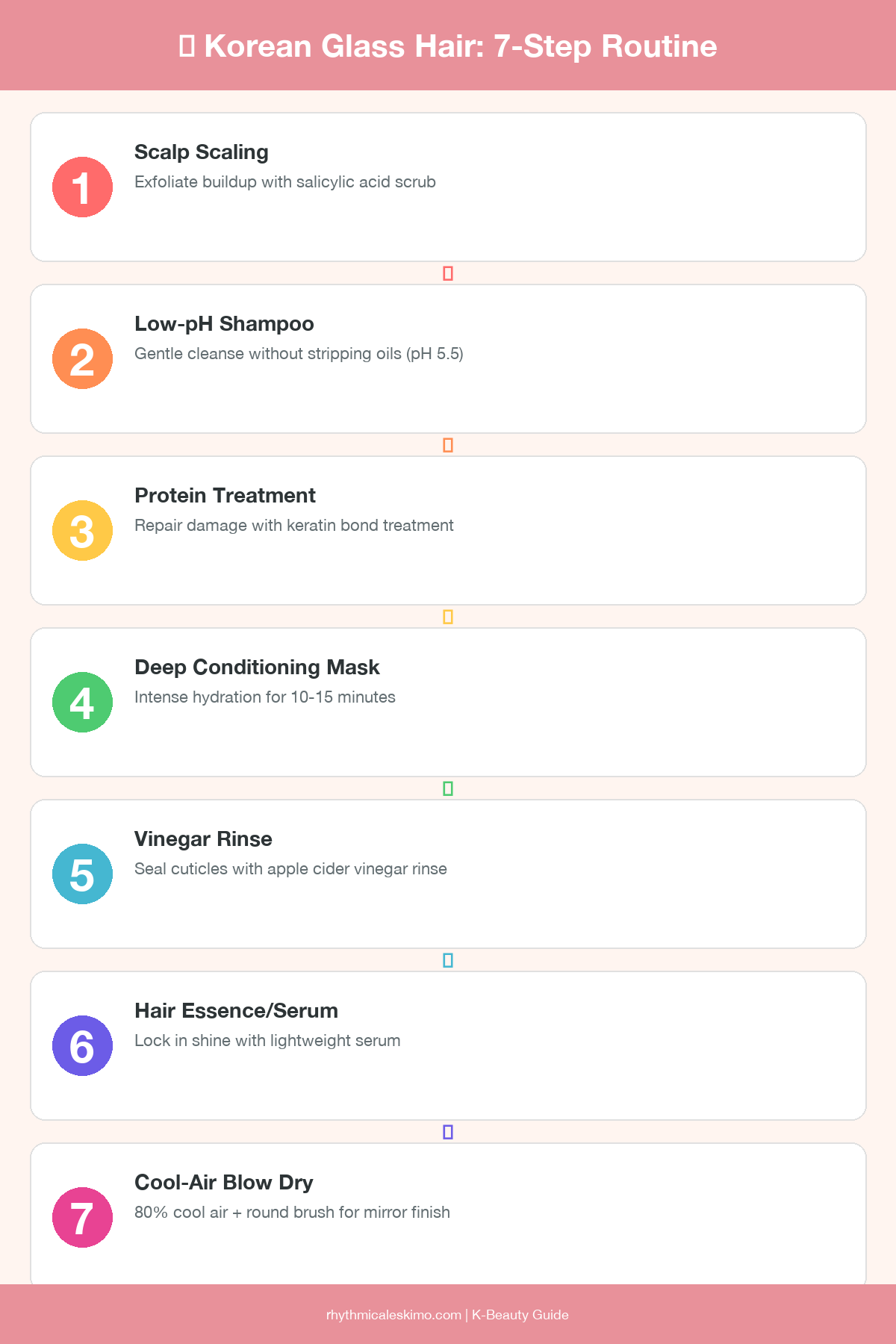
Save this infographic for your glass hair routine!
The Science Behind the Shine: Why Korean Hair Products Work Differently
Western haircare tends to focus on coating — silicones, heavy oils, and sprays that sit on top of the strand. Korean haircare takes the opposite approach: repair from the inside out.
Korean formulations rely on lightweight proteins, amino acids, and plant-derived ceramides that penetrate the cortex of each strand. When the inner structure is repaired, the outer cuticle naturally lies flat. And flat cuticles equal maximum light reflection — which is exactly what gives glass hair its signature shine.
Here is why this matters in practice:
- 31 proteins and amino acids — UNOVE’s Deep Damage Treatment uses this precise blend to seal microscopic gaps in the cuticle
- Low-pH formulas — Korean shampoos typically sit at pH 5.0-5.5, which keeps cuticles sealed (Western shampoos often hit pH 7+)
- Layered hydration — Like the famous 7-skin method for face, Korean haircare layers lightweight treatments rather than relying on one heavy product
- Scalp-first philosophy — Healthy hair starts at the root, which is why Korean routines always begin with scalp care
This scalp-first approach is exactly what makes Korean haircare unique. We covered the science behind it in our deep dive on Korean scalp care and how it leads to thicker, healthier hair.
The 7-Step Korean Glass Hair Routine
This is the exact routine that Korean hair stylists and beauty influencers use to achieve that mirror-shine finish. You do not need all seven steps every wash day — steps 1 and 4 are weekly treatments, while the rest are daily essentials.
For more Korean food adventures, explore our Dujjonku: Korea’s Viral Dubai Cookie [2026 Guide] guide.
Step 1: Scalp Scaling (Weekly)
Think of this as exfoliation for your scalp. Product buildup, dead skin cells, and excess sebum clog follicles and prevent healthy hair growth. A scalp scaler dissolves all of that.
How to do it: Apply the scaler to dry scalp in sections. Massage for 2-3 minutes with fingertips (never nails). Leave on for 5 minutes, then rinse thoroughly before shampooing.
Step 2: Low-pH Shampoo
This is non-negotiable for glass hair. A low-pH shampoo (5.0-5.5) cleanses without forcing cuticles open. High-pH shampoos — which includes most drugstore brands — lift the cuticle, causing frizz and dullness.
How to do it: Emulsify a coin-sized amount between palms first. Apply to scalp only — the suds running down your lengths are enough to clean them. Rinse with lukewarm (not hot) water.
Step 3: Protein Treatment Rinse
This is the secret weapon that separates Korean haircare from everything else. A protein treatment fills in gaps in the hair cortex, structurally repairing each strand from the inside.
How to do it: After shampooing, squeeze excess water from hair. Apply treatment from mid-lengths to ends. Wait just 10 seconds (Korean treatments are fast-acting), then rinse.
Step 4: Deep Conditioning Hair Mask (Weekly)
While the protein treatment repairs structure, a deep mask provides intense hydration. This is what gives glass hair its weight — that heavy, swinging quality that makes it look so luxurious.
How to do it: Apply generously from mid-lengths to ends. Use a wide-tooth comb to distribute evenly. Cover with a shower cap and leave for 10-15 minutes. Rinse with cool water to seal cuticles.
Step 5: Vinegar Rinse
This old-school Korean technique is making a massive comeback. Diluted vinegar (apple cider vinegar works best) balances scalp pH, removes mineral buildup from hard water, and seals the cuticle flat for maximum shine.
How to do it: Mix 2 tablespoons of apple cider vinegar with 1 cup of cool water. After conditioning, pour the mixture over your hair as a final rinse. Do not rinse it out — the smell disappears once hair dries.
Step 6: Leave-In Hair Essence or Serum
This is the step that makes the biggest visible difference. Korean hair essences are feather-light — nothing like the heavy serums you find in Western brands. They absorb into the strand rather than sitting on top, creating shine from within.
Speaking of innovative formats, the Dr. Melaxin Multi Balm delivers anti-aging peptides in a convenient stick.
How to do it: Pump 1-2 drops into palms. Rub hands together, then smooth over damp hair from mid-lengths to ends. Focus on the ends where damage is most visible. Do not apply to roots.
Step 7: Cool-Air Blow Dry with Brush Tension
The final step is technique, not product. Korean stylists use a specific blow-dry method that physically trains cuticles to lie flat.
How to do it:
- Rough-dry hair to 80% with warm air on medium heat
- Switch to a round brush. Starting at the roots, pull the brush down through each section while directing cool air along the strand
- The tension from the brush + cool air locks cuticles in the flat position
- Finish with a blast of cold air over the entire head for 30 seconds
Pro tip: Korean stylists always point the dryer nozzle downward along the hair shaft, never upward. Upward airflow lifts cuticles and causes frizz — the exact opposite of what you want.
Glass Hair Product Comparison: Price and Where to Buy
Here is a breakdown of every product in the 7-step routine, with prices across Amazon and YesStyle so you can find the best deal.
| Step | Product | Amazon Price | YesStyle Price | Best For |
|---|---|---|---|---|
| 1. Scalp Scaling | Aromatica Rosemary Scalp Scaling Shampoo | ~$18 | ~$16 | Oily/buildup-prone scalps |
| 2. Shampoo | Lador Keratin LPP Shampoo | ~$14 | ~$12 | All hair types, color-treated |
| 3. Protein Treatment | Moremo Hair Treatment Miracle 2X | ~$16 | ~$14 | Damaged/bleached hair |
| 4. Deep Mask | UNOVE Deep Damage Treatment EX | ~$22 | ~$20 | Severely damaged hair |
| 5. Vinegar Rinse | Elizavecca CER-100 | ~$8 | ~$7 | Budget-friendly shine boost |
| 6. Hair Essence | Mise en Scene Perfect Serum | ~$10 | ~$9 | Daily use, all hair types |
| 7. Blow Dry | Technique only | — | — | Round brush + cool air |
Salon Glass Hair Treatments vs. At-Home Routine
Korean salons offer professional glass hair treatments that deliver instant results. But are they worth the price? Here is an honest comparison.
Professional Salon Treatments
Keratin Treatment (Clinic Keratin): Korean salons use a formaldehyde-free keratin formula that smooths and straightens hair by infusing protein deep into the cortex. Results last 4-6 months. Cost in Korea: 150,000-300,000 KRW ($110-$220). Cost in the US/Europe: $250-$500.
Hair Glossing (Yun Meo-ri Treatment): A semi-permanent gloss coating that seals the cuticle and adds a reflective layer. Lasts 4-6 weeks. Cost in Korea: 50,000-100,000 KRW ($37-$74). Popular salon brand: Amos Professional, Korea’s top salon-exclusive brand used at Seoul Fashion Week.
Cinderella Treatment: A Korean-exclusive deep conditioning treatment that combines steam heat with a multi-layer protein mask. Takes about 45 minutes. Results are dramatic but fade after 3-4 weeks. Cost: 80,000-150,000 KRW ($60-$110).
At-Home Routine: The Verdict
The 7-step at-home routine will not give you the same instant transformation as a salon keratin treatment. But here is what it will do:
- Build cumulative results that actually improve your hair health (salon treatments are cosmetic only)
- Cost a fraction of salon visits — roughly $30/month vs. $200+ per salon session
- Give you control over ingredients (many salon keratin treatments still contain trace formaldehyde)
- Maintain salon results between visits — most Korean women combine both approaches
Our recommendation: Start with the at-home routine for 4-6 weeks. If you want even more dramatic results, get a professional glossing treatment and then maintain it with the 7-step routine at home. This is the most cost-effective strategy and what most Korean beauty influencers actually do.
Common Mistakes That Ruin Glass Hair
Even with the right products, these mistakes will sabotage your results:
1. Using hot water. Hot water forces cuticles open, undoing all your hard work. Always rinse with lukewarm or cool water. The final rinse should always be cold — this is the single most impactful free hack for shinier hair.
2. Skipping scalp care. If your scalp is clogged with buildup, no amount of serum will give you glass hair. The scalp scaling step is not optional — it is foundational.
3. Over-applying serum to roots. Hair essence goes on mid-lengths to ends only. Applying it to roots creates a greasy, flat look that is the opposite of glass hair’s bouncy shine.
4. Blow-drying with hot air only. The cool-air finish is what locks cuticles flat. If you skip the cold blast, your cuticles will lift as soon as hair cools naturally, and you lose the shine.
5. Using protein treatments too often. Protein overload makes hair brittle and straw-like. Stick to 1-2 times per week for the protein treatment (Step 3) and deep mask (Step 4). On other days, just shampoo, condition, and serum.
Sun protection matters for your hair just as much as your skin. UV damage breaks down the proteins you have worked so hard to rebuild. For the best Korean SPF options, see our guide on the best Korean sunscreens for 2026 — several of them make hair mists too.
Glass Hair for Different Hair Types
Glass hair is achievable for every hair type, but the approach varies:
Fine, straight hair: You are already closest to the glass hair ideal. Focus on lightweight products — Mise en Scene serum and Moremo treatment are your best friends. Skip heavy masks and use the vinegar rinse instead for shine without weight.
Thick, coarse hair: You will benefit most from the UNOVE Deep Damage Treatment and weekly deep masking. Apply the serum more generously (3-4 drops instead of 1-2). The blow-dry technique is especially important for you — take extra time with the brush tension step.
Curly or wavy hair: Glass hair does not mean pin-straight. Korean-style glass curls are a growing sub-trend — the goal is glossy, defined curls with zero frizz. Use all the same products but skip the round-brush blow-dry. Instead, diffuse on cool air and scrunch with serum.
Color-treated or bleached hair: This routine is actually ideal for you because the protein treatments repair the damage that bleaching causes. Use the Lador Keratin shampoo and UNOVE mask as your non-negotiable products — they were specifically formulated for chemically processed hair.
What Korean Celebrities and Stylists Say
Glass hair has been a staple on Korean red carpets and K-drama sets for years. Some notable advocates:
Amos Professional, Korea’s leading salon brand, was used to create runway looks during Hera Seoul Fashion Week 2025-2026. Their stylists credit the glass hair trend with shifting Korean haircare from a styling-focused industry to a treatment-focused one.
Base-K, a newer Korean brand, combines traditional ingredients like rice water, green tea, and bamboo with modern peptide technology. Their Thickening Duo uses matcha, clover flower, biotin, and peptides — a formula that bridges traditional Korean hair wisdom with cutting-edge science.
The glass hair trend is part of a broader K-beauty revolution happening in 2026. To understand the full picture, including trends like PDRN, exosomes, and bloom skin, check out our guide to the top K-beauty trends dominating 2026.
Related reading: Post-Procedure K-Skincare: Dermatologist Tips dives deeper into this topic.
If you want to explore further, our Bloom Skin: Korea’s New Glass Skin Secret for guide covers the essentials.
For more K-beauty recommendations, see our guide to Biodance Bio-Collagen Mask Review [2026 TikTok Hit].
Weekly Glass Hair Schedule
Here is how to structure your routine across the week for maximum results without overloading your hair:
| Day | Steps | Time Needed |
|---|---|---|
| Monday | Steps 2 + 3 + 6 + 7 (Shampoo, Protein, Serum, Blow Dry) | 20 min |
| Wednesday | Steps 1 + 2 + 4 + 5 + 6 + 7 (Full Routine) | 40 min |
| Friday | Steps 2 + 3 + 6 + 7 (Shampoo, Protein, Serum, Blow Dry) | 20 min |
| Sunday | Steps 2 + 4 + 6 + 7 (Shampoo, Mask, Serum, Blow Dry) | 30 min |
Between wash days: Apply 1-2 drops of Mise en Scene serum to dry ends as a refresh. This alone can maintain the glass effect for 2-3 days between washes.
Frequently Asked Questions
How long does it take to achieve glass hair?
Most people notice a significant difference after 2-3 weeks of consistent use. The protein treatments provide immediate shine, but the cumulative scalp care and cuticle repair take 4-6 weeks to reach full glass hair status.
Can I get glass hair with curly hair?
Yes. Glass hair does not require straight hair. The Korean “glass curl” sub-trend is growing fast — the goal is glossy, frizz-free curls with defined shine. Use the same products but diffuse instead of blow-drying with a round brush.
Is the glass hair routine safe for color-treated hair?
Absolutely. In fact, it is especially beneficial for color-treated hair because the protein treatments repair the cuticle damage that bleaching and dyeing cause. All products recommended in this guide are safe for chemically processed hair.
How much does the full glass hair routine cost?
The complete 7-step product lineup costs approximately $78-$88 depending on where you buy. These products last 2-3 months, making the monthly cost around $30-$40 — significantly cheaper than salon treatments.
What is the difference between glass hair and silk hair?
Glass hair emphasizes mirror-like reflective shine with high-gloss finish. Silk hair focuses on a softer, more matte smoothness. Think of glass hair as wet-look shine versus silk hair’s dry-satin finish. Both require cuticle care, but glass hair uses more serum and cool-air finishing.
Can men achieve glass hair?
Yes. Korean men have been early adopters of this trend. The routine works identically for men — in fact, shorter hair often shows glass-like results faster because there is less length to treat and cuticle alignment is easier to achieve.